Planning an Alaska cruise means running into two vocabularies at once — cruise-industry jargon and Alaska geography — and the brochures tend to assume you already know both. You don’t have to. Here’s a plain-English glossary of the terms you’ll actually meet, in two alphabetized groups: cruise and booking terms first, then Alaska nature and geography.
Alaska Cruise Glossary: Cruise & Booking Terms
Aft — The rear of the ship. Aft cabins and balconies are the glacier guideprized for wide, wake-facing views.
Balcony (veranda) — A cabin with a private outdoor space. Popular in Alaska for scenery, though not essential — see inside vs. balcony.
Bow (forward) — The front of the ship. Forward-facing lounges are prime glacier-viewing spots.
Cruisetour — A cruise packaged with a guided land tour (usually Denali) in a single booking, typically 10–14 days total. More in cruise vs. land tour.
Disembarkation — Getting off the ship, either at a port for the day or at the end of the cruise.
Drink package — A prepaid daily bundle for beverages. Often $60–$100 per day; worth it only if you drink several a day.
Embarkation — Boarding the ship, usually on day one at the homeport.
Gratuities — Daily tips for crew, typically $17–$25 per person per day, usually added automatically to your bill.
Homeport — The city where a cruise begins and ends (for Alaska, most often Seattle or Vancouver).
Inside (interior) cabin — A windowless cabin, the most affordable option. Dark and quiet — great for sleeping through Alaska’s long summer daylight.
Midship — The middle of the ship, where motion is least noticeable — best for anyone prone to seasickness.
Muster drill — The mandatory pre-departure safety briefing showing you where to go in an emergency.
Naturalist — An onboard expert who narrates wildlife, glaciers, and landscape, especially on scenic-cruising days.
Obstructed view — A window or balcony cabin with something (usually a lifeboat) partly blocking the view — cheaper as a result.
Ocean view — A cabin with a sealed window but no balcony — natural light without the balcony premium.
One-way (cross-Gulf) cruise — A sailing that starts and ends in different ports, typically between Vancouver and the Anchorage area (Seward or Whittier), crossing the Gulf of Alaska. Reaches glaciers round-trips often can’t.
Open-jaw — An airfare booking where you fly into one city and out of another — common with one-way cruises, and usually pricier than a round-trip flight.
Port (side) — The left side of the ship when facing forward.
Repositioning cruise — A one-way sailing when a ship moves between seasonal regions; often cheaper, but less convenient for flights.
Round-trip (Inside Passage) cruise — A sailing that returns to the same homeport, staying mostly in the sheltered Inside Passage. The simplest option for flights.
Scenic cruising — A day spent sailing (not docking) to view a glacier, fjord, or wildlife area from the ship. See the glacier guide.
Shore excursion — An organized activity in port. Often cheaper booked independently than through the ship — see excursions worth booking.
Shoulder season — The cheaper edges of the season (May and September), 30–50% below peak July. More in best time to cruise.
Starboard (side) — The right side of the ship when facing forward.
Suite — The largest, most expensive cabins, with extra space and premium perks like butler service.
Tender — A small boat that ferries passengers ashore when a ship can’t dock directly at a port.
Voyage of the Glaciers — A well-known one-way Princess itinerary crossing the Gulf, typically featuring College Fjord or Hubbard Glacier plus Glacier Bay.
Wave season — The January–March booking window when cruise lines offer their deepest discounts and perks for the coming year.
Alaska, glacier & wildlife terms
Aurora (Northern Lights) — Colorful night-sky displays, occasionally visible on late-September Alaska sailings.
Bergy bit — A medium chunk of floating glacier ice, bigger than a growler but smaller than an iceberg.
Breaching — When a whale launches most of its body out of the water — a highlight of Alaska whale watching.
Calving — When a chunk of ice breaks off a glacier’s face and crashes into the water, often with a thunderous crack.
College Fjord — A fjord in Prince William Sound holding five tidewater glaciers, seen only on one-way cruises.
Denali — North America’s tallest peak and the national park around it; the centerpiece of most Alaska land tours. Note: only about 30% of visitors catch any view of it, and a fully clear summit is rarer still.
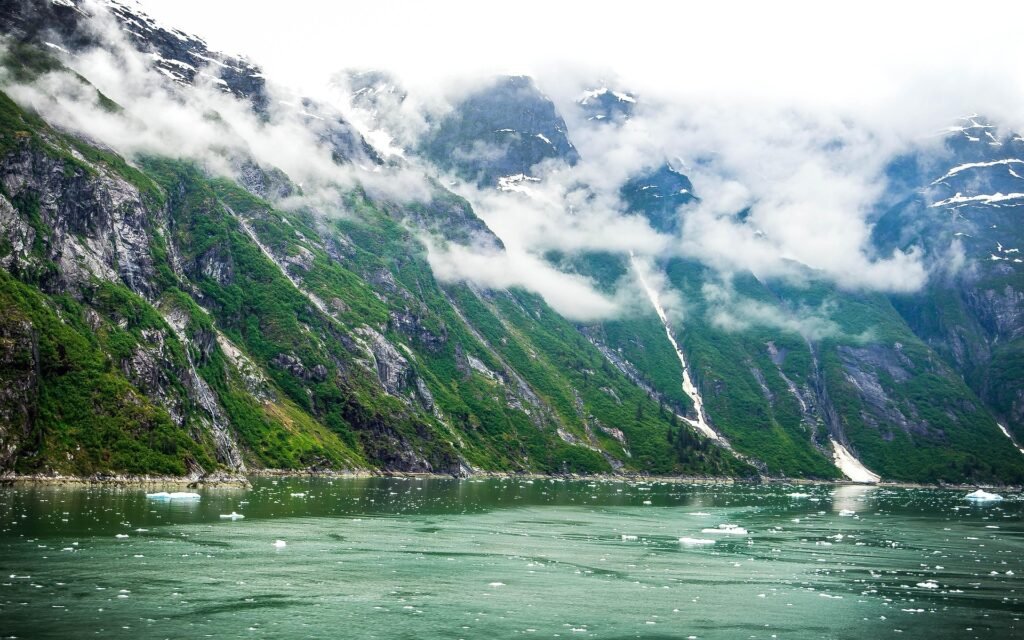
Fjord — A narrow, steep-walled sea inlet carved by a glacier — Tracy Arm is a classic example.
Glacier Bay — A permit-limited national park and UNESCO site with multiple tidewater glaciers and onboard park rangers. See the glacier comparison.
Growler — The smallest pieces of floating glacier ice, named for the sound they can make.
Hubbard Glacier — The largest tidewater glacier in North America, known for dramatic calving; usually on one-way itineraries.
Icefield — A vast, connected expanse of ice feeding many glaciers, such as the Juneau Icefield.
Inside Passage — The sheltered coastal route through Southeast Alaska’s islands and fjords, calm because it’s protected from open ocean. Home to the main cruise ports.
Kushtaka — A shape-shifting “land-otter man” from Tlingit folklore — you’ll hear it in local stories and Alaska “mystery” lore.
Muskeg — Boggy, spongy wetland terrain common across Southeast Alaska.
Southeast (Southeast Alaska) — The panhandle region where most cruises sail — Juneau, Ketchikan, Skagway, Sitka, and the Inside Passage.
Tidewater glacier — A glacier that flows all the way down to the sea, where it calves ice into the water. These are the glaciers cruises are built around.
Tlingit, Haida & Tsimshian — The primary Indigenous peoples of Southeast Alaska, whose totem art and living cultures you’ll encounter in the ports.
Tongass — The Tongass National Forest, the largest national forest in the U.S., blanketing much of Southeast Alaska in temperate rainforest.
Totem pole — A carved cedar monument recording clan stories, lineage, and history; Ketchikan holds the world’s largest collection of standing totem poles.
Tracy Arm / Endicott Arm — Neighboring narrow fjords south of Juneau; Tracy Arm leads to the Sawyer Glaciers, and ships reroute to Endicott Arm’s Dawes Glacier when ice blocks the way.
Keep it all in one place
Every one of these terms — plus port notes, an excursion tracker, and a budget — lives in one organized system in our Alaska Cruise Planner, which includes a glossary tab among its 25 tabs. And for the whole trip in context, start with the Alaska Cruise Planning Guide.
Now that the jargon makes sense, the rest of planning gets a lot easier.
Part of the Alaska Cruise Planning Guide — see all 12 posts in order →